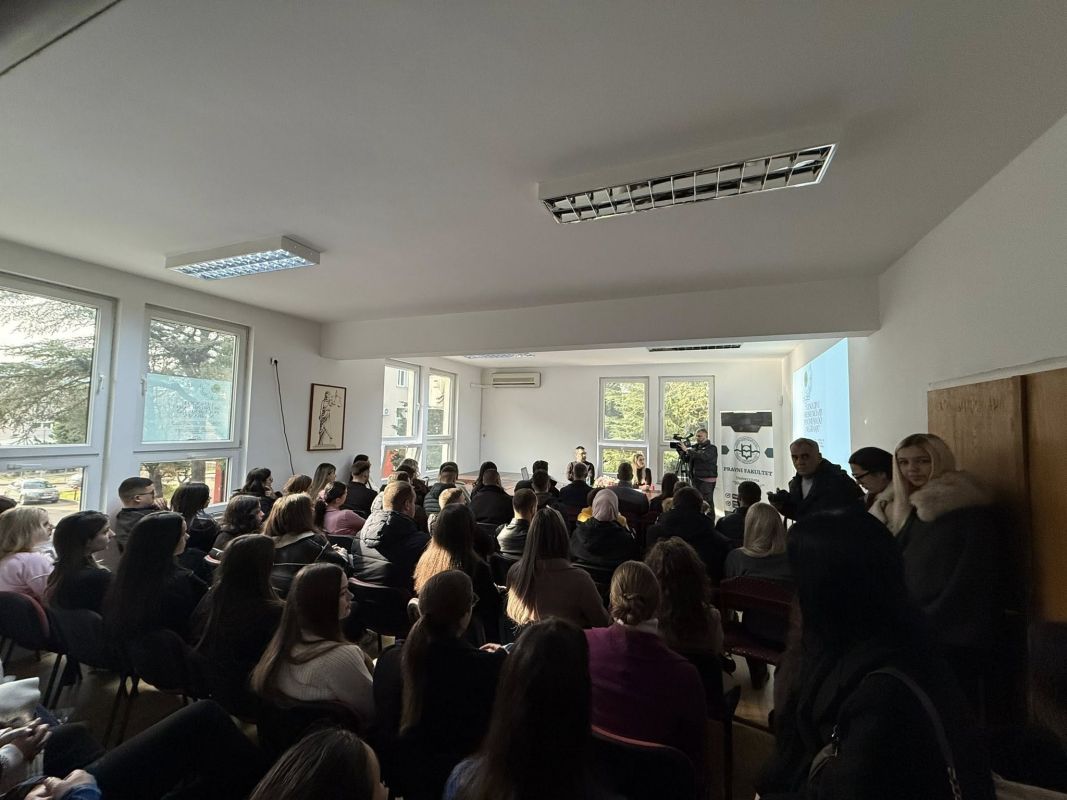
At the Faculty of Law of the University “Džemal Bijedić” in Mostar, a lecture titled “The Genocide in Srebrenica: From Commission to Denial” was held today, delivered by Dr. Muamer Džananović, Director of the Institute for Research of Crimes Against Humanity and International Law of the University of Sarajevo.
The program was opened by the Vice-Dean for Scientific Research, Assoc. Prof. Dr. Sunčica Hajdarović, who emphasized the importance of a scientific and academically responsible approach to studying the gravest crimes committed in Bosnia and Herzegovina.
In his lecture, Dr. Džananović highlighted that Bosnian society continues to face persistent denial of legally and historically established facts about the genocide in Srebrenica, stressing the crucial role of science and objective research. He also pointed out a positive shift in recent years, supported in part by the adoption of the UN Resolution on the Srebrenica Genocide, noting increased interest among faculties and professors in Bosnia and abroad to teach students based on verdicts of international, domestic, and regional courts.
However, he warned of a paradoxical societal reality in which genocide denial is often politically driven and subsequently passed on to younger generations through institutional mechanisms. He particularly emphasized issues within educational curricula in the Republika Srpska, where the military and police forces responsible for the genocide are portrayed in a positive light, with such lessons being mandatory even for Bosniak and Croat students.
Stressing the need to move away from ideological narratives and open space for a depoliticized, scientific approach, Dr. Džananović stated that this represents the first serious step toward building lasting peace. He also pointed out the insufficient investment in genuine scientific research, while political structures increasingly promote “folklorized” and “spectacularized” interpretations of wartime events, giving them unjustified credibility.
Throughout the lecture, he provided a historical overview of the events leading up to July 1995, emphasizing that the genocide was not an isolated act but the culmination of years of systematic violence against the Bosniak population. He presented numerous photographs, documents, data, and court verdicts that illustrate the course of events and the legal consequences of the genocide. Special attention was given to the final phase of genocide — its denial — which, as he explained, has been continuously carried out at institutional levels for nearly three decades.
At the conclusion of the lecture, Assoc. Prof. Dr. Sunčica Hajdarović summarized the key themes and linked the theoretical insights with current social developments. She particularly emphasized the problem of glorifying war criminals convicted by final verdicts in certain parts of Herzegovina, highlighting the importance of critical thinking, historical memory, and responsible public communication.
Such lectures play an essential role in students’ education, enabling them to better understand historical events and the legal implications of the genocide through academically grounded analysis.
(2).png)
(3).png)
.png)