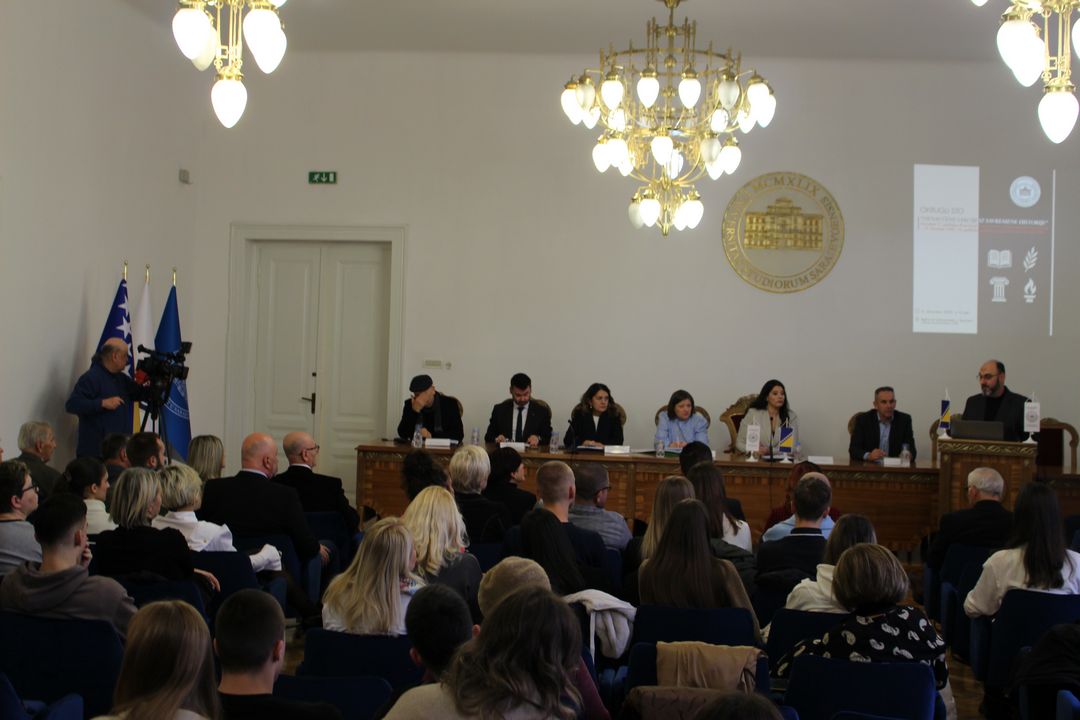
In the ceremonial hall of the Rectorate of the University of Sarajevo, a round table titled “Unlearned Lessons from Contemporary History” was held on December 9, 2025. The event was organized by the University of Sarajevo – Institute for Research of Crimes Against Humanity and International Law, on the occasion of the 77th anniversary of the Convention on the Prevention and Punishment of the Crime of Genocide and the 30th anniversary of the genocide in Srebrenica and its surroundings.
The event was opened by the Rector of the University of Sarajevo, Prof. Dr. Tarik Zaimović, with a welcoming address in which he emphasized the importance of this year’s activities of the Institute, particularly in the context of commemorating the 30th anniversary of the genocide. “With this event, the University and the Institute for Research of Crimes Against Humanity and International Law conclude this year’s exceptionally important activities. ‘Unlearned Lessons from Contemporary History’ proved to be an ideal title for the gathering to once again highlight that, unfortunately, the world has not learned the lesson.”
The opening of the event was accompanied by an introductory lecture from Dr. Muamer Džananović, Director of the Institute, who stated, among other things:
*"Genocide is a complex and multidimensional phenomenon that requires legal, sociological, historical, political, and philosophical understanding. Although the United Nations Convention on the Prevention and Punishment of the Crime of Genocide was adopted in 1948, the experiences of the 20th and 21st centuries show that the normative definition alone was not sufficient to prevent numerous mass crimes, neither in Bosnia and Herzegovina, nor in Rwanda, nor in current examples of humanitarian law violations in Gaza, Ukraine, and many other parts of the world.
Bosnia and Herzegovina holds a special place in the context of the application of the Genocide Convention, which was ratified by the then FNRJ in 1950, even though the term 'genocide' began to be frequently used in the public sphere only in the early 1990s, following the publication of Dedijer and Miletić’s book ‘Genocide against Muslims’.
The Convention gained practical application with the establishment of the ICTY and ICTR, which issued the first genocide convictions – including the conviction for genocide committed against Bosniaks. A particularly important milestone is the International Court of Justice judgment in the Case of Bosnia and Herzegovina vs. Serbia and Montenegro in 2007, as it represents the first time in history that a state was held responsible for violating the Convention for failing to prevent genocide. The Institute has published a credible translation of this ruling and made it available to the public."*
Experts in international law, history, and genocide studies participate in the round table, and the discussion topics include:
-
The meaning and application of the Genocide Convention,
-
Historical and contemporary challenges in prosecuting genocide,
-
Anthropological, ethnographic, and legal analyses of genocide,
-
The role of propaganda and dehumanization in committing mass crimes.
The round table provides participants, students, and guests the opportunity to actively engage in discussion, ask questions, and exchange knowledge.
In the first panel, the following speakers will present:
-
Prof. Dr. Enis Omerović (“From Lemkin to the International Court in The Hague: How the Genocide Convention Shapes the Contemporary International Order”),
-
Dr. Sabina Subašić Galijatović (“The History of the Genocide Convention: The Necessity of Interpretation in Light of its Purpose and Objective”),
-
Prof. Dr. Hariz Halilović (“Anthropology of Genocide and the Concept of Cosmological Destruction: Theoretical and Ethnographic Insights”),
-
Dr. Merisa Karović Babić (“Never Again? From the Delayed Genocide in Srebrenica to Events in Gaza”), and
-
Dr. Elvedin Mulagić (“Genocide against the Tutsi in Rwanda”).
In the second panel, the following speakers will present:
-
Dr. Sabahudin Šarić (“The Retreat of Law and Justice Before Ideology”),
-
Doc. Dr. Sunčica Hajdarović (“From Legal Norm to Social Practice: Why Punishing Denial of Genocide is Important”),
-
Dr. Almir Grabovica (“The Role of the German Judiciary in Prosecuting Genocide in Bosnia and Herzegovina: Standards of the Genocide Convention”),
-
Dr. Jasmin Medić (“‘Lying is Permitted’: Propaganda and Dehumanization Before the Holodomor, Holocaust, and Genocide against Bosniaks”), and
-
Mr. Lamija Muftić (“The Genocide Convention: Practice of International Judicial Instances in the Context of Crimes in Palestine”).
.JPG)
.JPG)
.JPG)
.JPG)

(2).png)
(3).png)
.png)