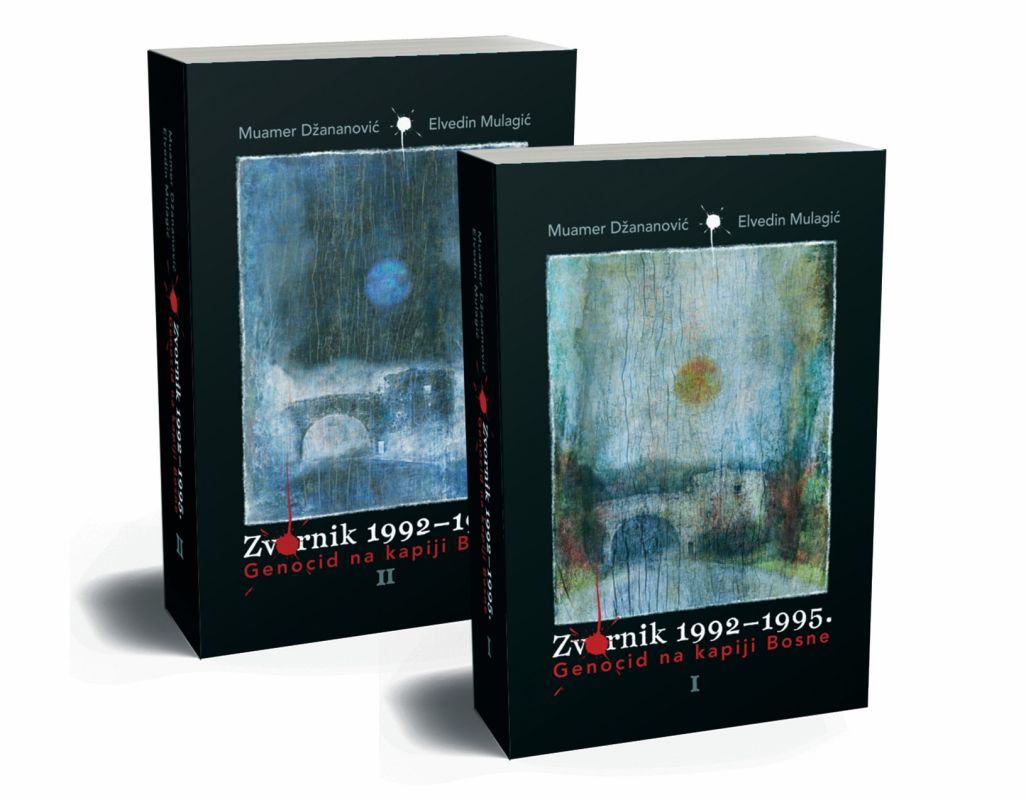
The University of Sarajevo – Institute for Research of Crimes against Humanity and International Law has published a two-volume book titled “Zvornik 1992–1995: Genocide at the Gateway of Bosnia” by Dr. Muamer Džananović and Dr. Elvedin Mulagić. The work comprises 1,400 pages organized into 15 chapters, with more than 4,500 footnotes, as well as extensive appendices including systematized lists of victims, lists of mass graves exhumed in the Zvornik area, and other relevant documentation.
The book is the result of a ten-year empirical scientific research project conducted by the authors under the auspices of the Institute. The project included the review and analysis of extensive archival materials, more than 200 field video interviews personally recorded by the authors with victims and witnesses, and the collection and processing of several thousand questionnaires concerning killed and missing persons. The research project established two fundamental components of the study: documenting and determining all committed war crimes, and compiling a list of victims—those missing and killed—in the municipality of Zvornik during the period 1992–1995, as part of the genocide against Bosniaks. During the implementation of the research, a network of numerous enumerators and other collaborators was established in returnee communities in the Zvornik area. The appendices present the identities, basic biographical data, and circumstances of killing or disappearance for a total of 2,472 victims in the municipality of Zvornik during the period 1992–1995, including 392 residents of Zvornik who were killed in the genocide in Srebrenica and its surroundings.
The authors conducted a detailed analysis of the political, military, and police structures involved in the planning, command, and execution of crimes, including the institutions of Serbia and Montenegro, the State Security Service of Serbia, the Yugoslav People’s Army, the Army of the “Republika Srpska,” paramilitary units, the bureaucratic apparatus of the “Serb Municipality of Zvornik,” as well as other bodies and perpetrators involved in the crimes.
“The book thoroughly and systematically, with an exceptionally large number of sources and collected pieces of evidence, examines all mass and individual crimes committed in the villages, settlements, and streets of Zvornik. A separate chapter presents the system of concentration camps in Zvornik, which was among the most systematic during the 1992–1995 period and represented the largest site of suffering of Bosniaks from Zvornik. With the aim of establishing scientific and historical truth, the work also addresses crimes committed against Roma and members of other ethnic groups in the municipality of Zvornik during the 1992–1995 period.”
Through their research, the authors reached scientific conclusions that the crimes committed against the Bosniaks of Zvornik between 1992 and 1995 were planned and carried out as a result of the implementation of the first and third strategic objectives of the “Serb people in Bosnia and Herzegovina” in the Zvornik area. Crimes against the residents of Zvornik up to the end of 1995 were the result of efforts to fully realize the third strategic objective, namely the decision to “remove” the entire Bosniak population from the area up to 50 kilometers along the left bank of the Drina River. The authors’ scientific findings indicate that in every critical phase of the implementation of these strategic objectives—during the occupation of Zvornik in April 1992, during the reduction of the territory of the Kamenica–Cerska–Konjević Polje–Srebrenica–Žepa enclaves in early 1993, and during the military offensive on the territory of Sapna in 1995—large military and police forces from Serbia were deployed.
The authors conclude that, given the crimes committed in Zvornik up to July 1995, as well as those carried out during the genocide in Srebrenica and its surroundings within the territory of Zvornik, this municipality became the local community with the highest number of killed and missing civilian victims on its territory. They therefore argue that Zvornik represents a key geographical determinant of crimes, execution sites, and mass graves in the wars in the territory of the former Yugoslavia at the end of the 20th century.
The work also includes abbreviations as well as indexes of names and geographical terms, further facilitating the use of the publication for scientific and research purposes. Of particular documentary value is the topographic map included with the book, on which sites of mass killings, camps, and other locations associated with the commission of crimes in the Zvornik area during the 1992–1995 period are systematically marked.
The review panel consists of Academician Prof. Dr. Mirko Pejanović, Prof. Dr. Edina Bećirević, Dr. Jasmin Medić, Prof. Dr. Hariz Halilović, and Dr. Zilha Mastalić Košuta. The editor of the book is Dr. Hikmet Karčić. Language editing was done by Mr. Sadžida Džuvić, DTP preparation by Mr. Sead Muhić, and the cover was designed by Dr. Adis Elias Fejzić.
The reviewers and the editor assessed the work as one of the most extensive and methodologically thorough research studies on crimes committed in Bosnia and Herzegovina during the aggression of 1992–1995.
Academician Prof. Dr. Mirko Pejanović describes the book as a monumental, comprehensive, and capital scientific work that represents an exceptionally important, original, and deeply documented contribution to contemporary historiography. According to his assessment, the book provides a complete scientific understanding of war crimes and genocide and possesses immeasurable documentary, educational, and historical value. Pejanović emphasizes that the work is not only a scientific study but also a voice of truth in a time of increasingly pronounced denial of crimes, deserving the highest scientific and social respect.
Prof. Dr. Edina Bećirević assesses the book as an exceptionally important and indispensable study of contemporary genocide historiography, emphasizing that the crimes are documented with near forensic precision and great analytical depth. She particularly highlights that the authors do not present genocide as an isolated event, but as a long-term, multi-phase, and strategically planned process, culminating in July 1995. According to her assessment, the work successfully connects macro-, meso-, and micro-levels of analysis and exposes the mechanisms of local operationalization of genocidal policy, thereby dismantling narratives of spontaneous violence. In this context, the two-volume work represents a highly valuable contribution not only to Bosnian-Herzegovinian but also to global academic production on genocide. Bećirević concludes that the authors deserve gratitude from both the academic community and the wider public for their thorough, courageous, and intellectually honest work.
Dr. Jasmin Medić emphasizes that this is a methodologically grounded and historiographically highly significant work that avoids the trap of localization and places events in Zvornik within the broader political and military context of the breakup of Yugoslavia and the aggression against Bosnia and Herzegovina. He particularly stresses that Zvornik is the first municipality in Bosnia and Herzegovina where crimes have been systematically, thoroughly, and professionally examined, and that the book serves as a guide for future researchers through its strong empirical and oral history approach.
Dr. Zilha Mastalić Košuta describes the book as a harrowing, courageous, and invaluable testimony that clearly shows that crimes in Zvornik were not spontaneous but planned and systematically carried out. She emphasizes that the work goes beyond mere facts and powerfully illuminates the psychological and emotional consequences of genocide, making it both a historiographical record and an ethical act of witnessing.
Prof. Dr. Hariz Halilović assesses the book as a monumental work and indispensable reading for genocide researchers, emphasizing that it offers a comprehensive reconstruction of genocidal violence in the Drina Valley and clearly demonstrates its systemic, planned, and coordinated character. He highlights the continuity of genocide from 1992 to 1995 and the work’s key contribution to interdisciplinary genocide studies, establishing new methodological standards.
The editor of the book, Dr. Hikmet Karčić, emphasizes that the work represents the most comprehensive scientific-empirical research of war crimes in contemporary Bosnian-Herzegovinian historiography concerning the period of aggression against the Republic of Bosnia and Herzegovina, and that it sets a benchmark for how crimes should be researched and analyzed in modern academic practice.
(2).png)
(3).png)
.png)