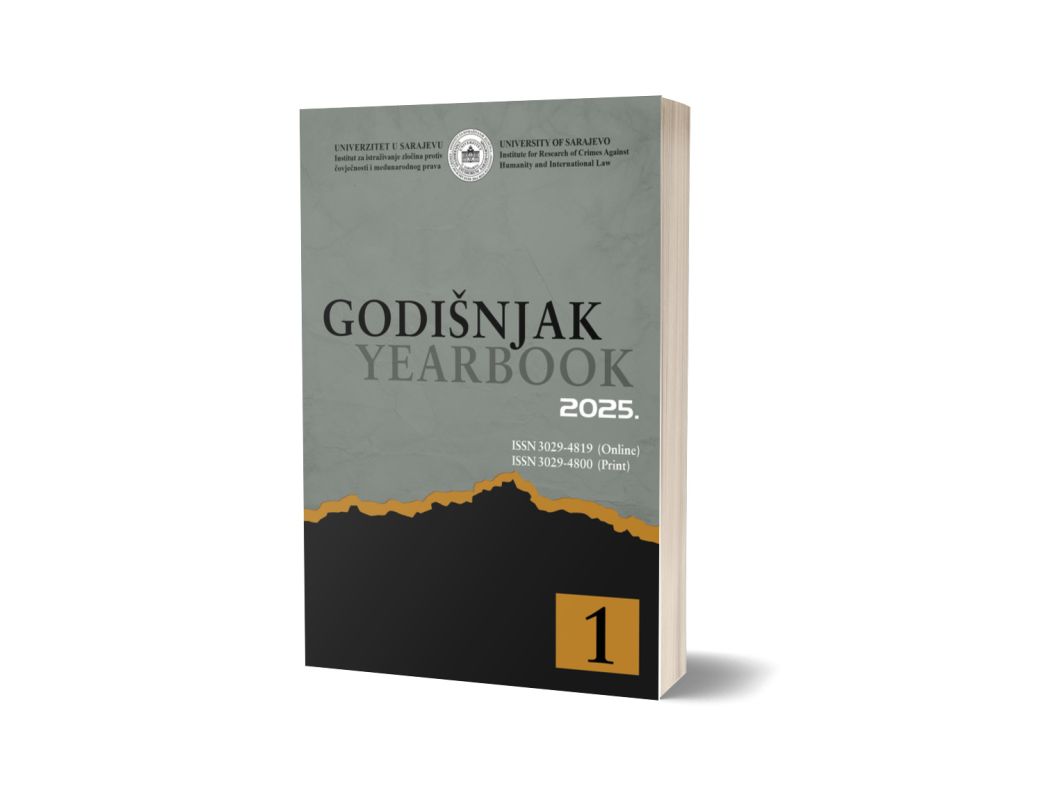
The University of Sarajevo – Institute for Research of Crimes against Humanity and International Law has published the first issue of its Yearbook.
The Yearbook of the Institute is an interdisciplinary journal dedicated to the study of genocide, crimes against humanity, war crimes, and other serious violations of international law. The first issue of the Yearbook contains twelve scholarly articles by authors from Bosnia and Herzegovina and abroad, published in Bosnian or English. These contributions address historical, legal, social, and memory-related aspects of mass violence, with a particular focus on Bosnia and Herzegovina in a comparative international context.
The thematic framework covers the period from the Balkan Wars of 1912–1913 to contemporary analyses of genocides committed at the end of the twentieth century. The articles examine issues of mass persecution and ethnic violence, the legal qualification of genocide and “ethnic cleansing,” the jurisprudence of international and national courts, the application of universal jurisdiction, as well as the phenomenon of genocide denial and relativization. Special attention is devoted to the methodological challenges of documenting crimes and recording victims, including critical source analysis, the standardization of research procedures, and the scientific verification of data. A significant segment of the contributions focuses on the gender dimension of genocide and wartime violence, including systematic sexual violence and gender-based killing as integral elements of genocidal policies in Bosnia and Herzegovina. The Yearbook also addresses post-genocide processes of return, social reintegration, and belonging, as well as the role of education, cultures of memory, and memorial practices in confronting the past and preventing future crimes.
The final section of the Yearbook presents a thematically structured bibliography of the publishing activities of the Institute for Research of Crimes against Humanity and International Law for the period 1995–2025. This bibliography provides insight into the continuity of research interests and methodological approaches in the fields of genocide studies and international law.
In the foreword to the first issue of the Yearbook, Dr. Muamer Džananović, Editor-in-Chief, provides a brief overview of the Institute’s historical development and growth, and introduces the published articles and the reasons for launching the journal.
In the article by Dr. Safet Bandžović, Senior Research Advisor at the University of Sarajevo – Institute of History, “The Brutality of Wars and the Reach of the Dehumanization of the Balkans (1912–1913),” the author analyzes the Balkan Wars of 1912–1913 as a period marked by mass crimes and persecution of the Muslim population.
In the article by Prof. Dr. Enis Omerović, Associate Professor and Dean of the Faculty of Law at the University of Zenica, “‘Ethnic Cleansing’ – Announcement of Genocide, Its Means and Its Goal?”, the legal nature and meaning of the term “ethnic cleansing” in international law are examined, particularly in the context of the armed conflict in Bosnia and Herzegovina.
In the article by Dr. Elvedin Mulagić, “Denial of Genocide – The Case of the Genocide against Bosniaks and the Genocide against the Tutsi,” the author examines the denial of the genocide against the Tutsi in Rwanda and the genocide against Bosniaks in Bosnia and Herzegovina, committed almost simultaneously and within the same international context of the 1990s.
In the article by Dr. Almir Grabovica, Research Associate at the University of Sarajevo – Institute for Research of Crimes against Humanity and International Law, “Universal Jurisdiction and the German Criminal Code: Application in Judgments for the Crime of Genocide in the Republic of Bosnia and Herzegovina,” the application of the principle of universal jurisdiction is analyzed through the practice of German courts in prosecuting the crime of genocide committed during the aggression against the Republic of Bosnia and Herzegovina.
In the co-authored article by Bekir Hodžić and Dr. Sarah Snyder, a student research assistant and visiting researcher at the Center for the Study of Genocide and Human Rights at Rutgers University, “Recalling Srebrenica: Furthering Education on the Genocide in Bosnia and Herzegovina within the United States,” the genocide in Bosnia and Herzegovina is analyzed within educational and curricular frameworks in the United States.
In the article by Dr. David J. Simon, Director of the Genocide Studies Program at Yale University, and Sophie Foster, a researcher in the same program, “Return and Belonging – Three Decades of Struggle in Srebrenica,” the process of return and reintegration of genocide survivors in Srebrenica in the post-war period is examined.
In the article by Tali Nates, Director of the Johannesburg Holocaust and Genocide Centre, “Using Multidirectional Memory to Learn about War and Genocide in Bosnia and Herzegovina 30 Years Later,” the concept of multidirectional memory is explored as an approach to learning about war and genocide in Bosnia and Herzegovina.
In the article by Dr. Zilha Mastalić Košuta, Senior Research Associate at the University of Sarajevo – Institute for Research of Crimes against Humanity and International Law, “Source-Based Grounding and the Methodological Framework in the Process of Documenting Crimes against the Serbian Population in Sarajevo: A Critical Analysis of Lists and Reports,” a critical evaluation is provided of available lists and reports on killed and missing civilians of Serbian nationality in Sarajevo during the period 1992–1995.
In the article by Dr. Merisa Karović-Babić, Senior Research Associate at the University of Sarajevo – Institute for Research of Crimes against Humanity and International Law, and Elvira Toković, MA, Operations Associate at the Institute, “The Siege and Killing of Sarajevo’s Population in 1992,” the results of research on the number, identities, and circumstances of civilians killed in Sarajevo during the first year of the siege are presented.
In the article by Mersihа Jaskić, MA, an employee of the Center for Social Research Sarajevo, and Dr. Jasmin Medić, Senior Research Associate at the University of Sarajevo – Institute of History, “Survivors Speak the Truth: Crimes against Women in the Omarska Camp,” crimes committed against detained women in the Omarska camp during the period from May to August 1992 are analyzed.
In the article by Prof. Dr. Pınar Akarçay, Director of the International Institute for Genocide and Crimes against Humanity at Istanbul University, and Hilal Ur, MA, a graduate of genocide studies at the same Institute, “‘Gendercide’ and Rape as Strategic Tools in the Genocide in Bosnia,” the genocide in Bosnia and Herzegovina is examined through a gender perspective, with a focus on the systematic killing of men and mass sexual violence against women as integral components of genocidal strategy.
In the Bibliography section, Mr. Sci. Sadžida Džuvić, Lecturer at the University of Sarajevo – Institute for Research of Crimes against Humanity and International Law, presents “Thirty Years of Publishing Activity of the Institute for Research of Crimes against Humanity and International Law (1995–2025): A Bibliography of Publications.” The section presents the Institute’s publications from its first publication in 1995 to its most recent editions.
The Editorial Board of the Yearbook consists of: Dr. Gregory Stanton (George Mason University, United States), Dr. Samuel Totten (University of Arkansas, United States), Dr. Eric Ndushabandi (University of Rwanda, Rwanda), Dr. Rosa Aloisi (Trinity University, United States), Dr. Onur Uraz (Hacettepe University, Republic of Türkiye), Dr. Nike Wentholt (University of Humanistic Studies, Utrecht, Kingdom of the Netherlands), Dr. Sarah Wagner (The George Washington University, United States), Dr. Selman Dursun (University of Istanbul, Republic of Türkiye), Dr. Hariz Halilovich (Royal Melbourne Institute of Technology – RMIT, Australia), Dr. James Waller (University of Connecticut, United States), Dr. Adnan Jahić (Faculty of Philosophy, University of Tuzla, Bosnia and Herzegovina), Dr. Ermin Kuka (University of Sarajevo – Institute for Research of Crimes against Humanity and International Law, Bosnia and Herzegovina), Dr. Merisa Karović-Babić (University of Sarajevo – Institute for Research of Crimes against Humanity and International Law, Bosnia and Herzegovina), Dr. Enis Omerović (Faculty of Law, University of Zenica, Bosnia and Herzegovina), Dr. Safet Bandžović (University of Sarajevo – Institute of History, Bosnia and Herzegovina), Dr. Zilha Mastalić Košuta (University of Sarajevo – Institute for Research of Crimes against Humanity and International Law, Bosnia and Herzegovina), and Dr. Hikmet Karčić (University of Sarajevo – Institute for Research of Crimes against Humanity and International Law, Bosnia and Herzegovina).
By publishing the Yearbook, the Institute has made a significant step forward in strengthening its scientific and research activities. In the forthcoming period, a call for papers for the second issue of the Yearbook will also be announced.
(1).jpg)
(2).png)
(3).png)
.png)