On April 5, 1992, a football match was scheduled to be played at Grbavica Stadium between the Sarajevo club Željezničar and the Belgrade club Rad. However, gunfire from the direction of Vraca signaled the onset of war conditions in the city and prevented the match from taking place. Sarajevo’s newspaper Oslobođenje reported: “Heavy fire around the stadium postponed the match for another occasion. (…) Grbavica remained deserted. The shooting did not stop even after several hours. It was the darkest day in the sporting history of this venue.” (Oslobođenje, April 6, 1992).
In the following text, we present details on how the capital of the Republic of Bosnia and Herzegovina was placed under siege, as well as the plans and territorial ambitions of the SDS and other proponents of the idea of a Greater Serbia to divide a multiethnic and multinational city into mono-ethnic areas, i.e., into a “Serb and Muslim part.”
During the second half of 1991, the SDS president, Radovan Karadžić, on several occasions indicated his intention to blockade Sarajevo. In a telephone conversation from September 8/9, 1991, with Slobodan Milošević, Karadžić angrily foreshadowed catastrophe and the spread of conflict to Bosnia and Herzegovina, stating that “Romanija has informed me that they are preparing to block Sarajevo, no one will be able to leave the city, it will be a catastrophe,” noting that this would serve as a threat to Izetbegović. On the same day, in a conversation with Nikola Koljević, Karadžić stated: “We will blockade Sarajevo! No one will be able to leave Sarajevo in any direction,” and he repeated similar ideas in conversations with Momčilo Mandić and Vitomir Žepinić. The plan to blockade the city was published by journalists of Slobodna Bosna in the second half of November 1991. They emphasized that, in connection with the ongoing regionalization into so-called Serbian Autonomous Regions (SAOs), the SDS had formed a War Staff intending to block the city and separate it from the rest of the Republic. The most frequented route connecting the city with central and western Bosnia would be blocked at Krivoglavci (Vogošća). According to the plan, the road to northeastern Bosnia would be blocked at Nišići (Ilijaš), while the connection with eastern Bosnia would be cut in the area of Mokro.
The first phase of the blockade followed just hours after the closing of polling stations in the legally conducted referendum on the independence of Bosnia and Herzegovina. On the night of March 1/2, 1992, masked and armed SDS members, in coordination with the political leadership of the rump Presidency of the SFRY, erected barricades at key entrances and intersections in the city.
During this period, Radovan Karadžić, Momčilo Krajišnik, and Nikola Koljević, as members of the presidency of the self-proclaimed Serbian Republic of Bosnia and Herzegovina, attended a meeting of the rump SFRY Presidency in Belgrade. At this session, the acting president of the Presidency, Branko Kostić, supported the unconstitutional actions and ethnonational policy of SDS representatives from Bosnia and Herzegovina, stating: “(...) we do not expect to divide, nor to draw any borders among ourselves; if borders are to be drawn, then they will probably first be drawn between individual ethnic groups in Bosnia.” Since Karadžić was in Belgrade at the time following the referendum, he issued instructions for setting up barricades to the president of the SDS Crisis Staff, Rajko Dukić. In a telephone conversation, Karadžić stated: “Let them close everything tonight. (…) Let them close all exits (…) Let it be done swiftly.”
Following Karadžić’s instructions, Rajko Dukić, responsible for closing all approaches to the city, reported on March 2 that the task had been successfully completed: “Everything is cut off (…) we control everything (…) everything is blocked. Everything here is under control. We had contact with the army” (ICTY transcripts of intercepted telephone conversations between Rajko Dukić and Radovan Karadžić, March 1–2, 1992). In response to the complete blockade, a large number of Sarajevo citizens spontaneously took to the streets in protest, singing patriotic songs and chanting slogans such as “We will not give up Bosnia,” “We will live together,” “We want peace,” and “Down with the barricades.” Several attacks on journalists were recorded near the barricades, and during their duration, four people were killed and three wounded in Sarajevo. According to Dukić’s report, on March 2 not a single bus entered or left the city, and tram, trolleybus, and bus traffic within the city was halted.
In the continuation of the text, we present only some examples of the extremely complex role of the Yugoslav People’s Army (JNA) in placing the city under siege, for which there is extensive material evidence, including documents from the Command of the 2nd Military District.
The conclusions from the assessment of the situation in Bosnia and Herzegovina dated March 20, 1992, by the commander of the Second Military District, Colonel General Milutin Kukanjac, state the following: “The commander of the 4th Corps, together with a group of officers, is consolidating all units in the Sarajevo garrison and its immediate surroundings. With officers from platoon commanders and above, detailed reconnaissance of possible directions and methods of action has been carried out.” The document further states that the 240th air defense missile regiment was relocated to the Sokolac area, and that “the passage through Sarajevo was very effective; the regiment reached its new location without any problems, as all necessary measures were taken in a timely manner.” It was planned that by relocating all types of weapons, ammunition, and reserves from the Butile warehouse and the Territorial Defense warehouse in Konjic to the areas of Pale and Han Pijesak, their “security and use by the JNA” would be ensured.
The March barricades placed at the entrances and main roads within the city represented the first phase of the siege of Sarajevo. During March 1992, part of the 364th light artillery regiment took up positions in the areas of Butmir Airport and Brus, and with the April 1 occupation of the water reservoir on Mojmilo hill by six armored personnel carriers from the Lukavica barracks, along with the deployment of part of the 4th Corps command to Zlatište, the JNA largely occupied key and strategic positions around Sarajevo and assisted the SDS in dividing certain Sarajevo municipalities along ethnic lines.
As international recognition of the Republic of Bosnia and Herzegovina became increasingly likely, the Chief of the General Staff of the SFRY Armed Forces, Colonel General Blagoje Adžić, issued an order to “as soon as possible begin forming headquarters, detachments, and brigades of volunteer units of reduced composition and adequately fill them with officer personnel from the JNA, as well as weapons and equipment,” and to relocate all weapons and technical material from “threatened facilities,” in order to prepare the ground for taking control of as much territory as possible, in accordance with SDS instructions from December 1991. At the same time, SDS and JNA members occupied Sarajevo Airport and the Center for Training of Ministry of Interior personnel at Vraca in the first days of April, thereby taking control of very important institutions in the city.
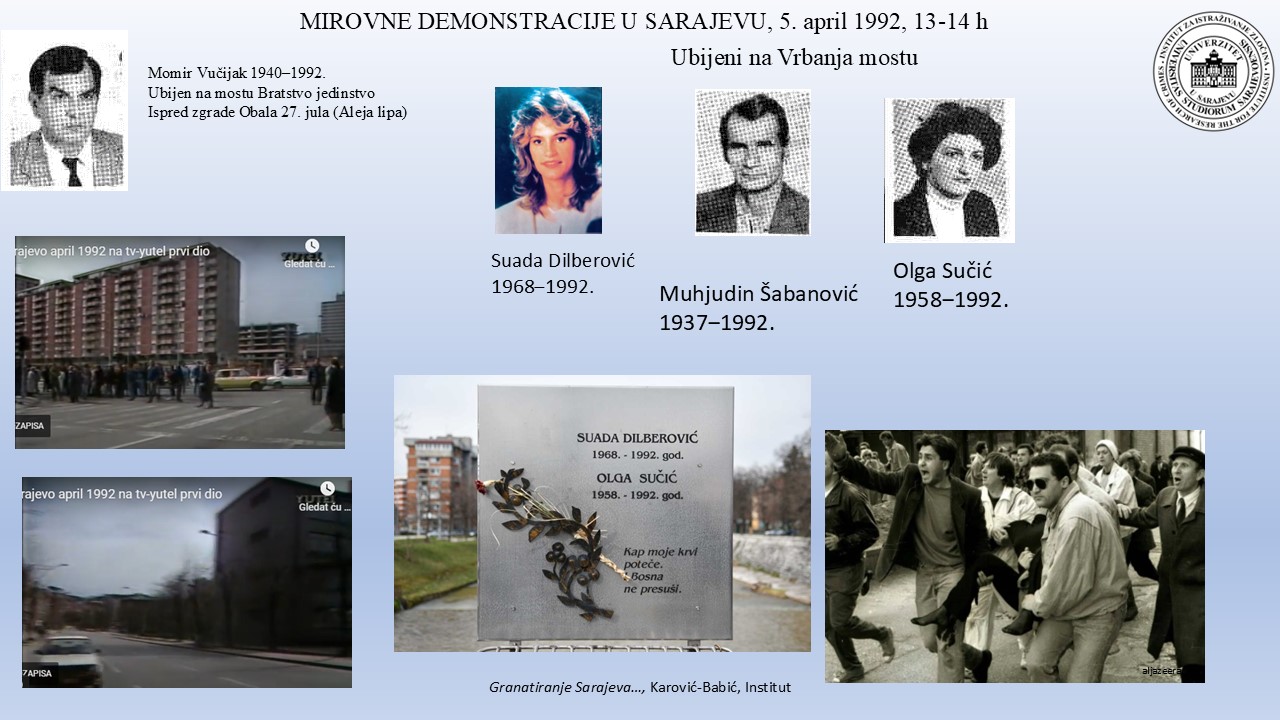
The aforementioned match between Željezničar and Rad, scheduled for April 5, was prevented by heavy gunfire from the direction of Vraca. While these attacks were ongoing, in the afternoon of April 5, 1992, the March protests of Sarajevo citizens were repeated, with large crowds gathering in front of the Assembly and moving to dismantle SDS barricades at Kovačići. From these barricades—specifically from the direction of a gas station at Kovačići and the “Dimnjačar” building—fire was opened on a group of citizens on Vrbanja Bridge, killing three and wounding four civilians. Those killed were Muhidin Šabanović, Suada Dilberović, and Olga Sučić. At the same time, armed SDS members fired from the direction of Vraca at demonstrators on the Brotherhood and Unity Bridge, seriously wounding one civilian, Miomir Vučijak, who later died in hospital.
The shooting at unarmed civilians failed to disperse the demonstrators, who around 2:00 p.m. broke into the building of the republican Assembly and proclaimed a “people’s parliament.” Their demands included the resignation of the Government and Presidency of SRBiH, the urgent convening of the Assembly, the formation of a government of national salvation, and early elections. The manifestation “We Are for Peace” continued throughout the night and the following day, with over 150 public and cultural figures addressing the crowd.
In a report submitted by JNA Colonel Zekanović to the General Staff of the SFRY Armed Forces, these activities of the citizens were described positively: “The committee leading this manifestation formed, around 5:00 p.m. on April 6, a government of national salvation composed of 15 members of all nationalities. One of its conclusions is that the JNA should be placed in the service of the people and proceed with the disarmament of all paramilitary formations,” by which he referred to the defense forces of the Republic of Bosnia and Herzegovina—effectively implying the retention of Bosnia and Herzegovina within the truncated Yugoslavia.
While citizens at the “parliament session” during the night of April 5/6 demanded the resignation of the government and early elections, the municipality of Stari Grad—especially the Jarčedoli neighborhood—was bombarded from the directions of Lapišnica, Crepoljsko, Hreša, Mrkovići, and Trebević. Omer Behmen, vice president of the SDA, told the demonstrators that they could protest as much as they wished “while Chetniks descend from Brus.” In mixed patrols that visited Jarčedoli the next day, April 6, was also medical colonel Mladenović from the Command of the Second Military District, whose units had participated in the shelling. A regular operational report submitted that same day noted continuous coordination with the Crisis Staff in Pale and monitoring of combat activities in and around Sarajevo.
As the “parliament session” continued on April 6, citizens from Zenica, Tuzla, Kakanj, Fojnica, and other towns joined Sarajevo’s protesters. In response, Karadžić ordered a complete closure of the city, stating that no buses should be allowed to enter from Semizovac or Ilijaš and that all access points must be fully blocked. On the return journey of buses carrying participants from other cities, armed individuals at SDS barricades fired on one of the buses between Ilijaš and Visoko, killing Novo Kojić and wounding others. Karadžić further threatened that if the crowd attempted to move toward Vraca, “they would all be killed.”
The demonstrators remained in front of the Assembly building, where around 2:00 p.m. sniper fire from the Holiday Inn hotel wounded seven civilians. On the same day, the Presidency of SRBiH concluded that a state commission should be formed to determine responsibility for the shootings and that an immediate ceasefire must be ensured. However, responsibility was never established, despite arrests of SDS snipers in the hotel.
By taking control of parts of Sarajevo municipalities and placing barricades at key access points, Sarajevo was effectively placed under siege. JNA forces had already reconnoitered and gradually occupied strategic positions around the city. This line remained largely unchanged throughout the siege. During April and May 1992, the JNA played a central role in occupying parts of Sarajevo and encircling the city. In May 1992, the 4th Corps was transformed into the Sarajevo-Romanija Corps of the Army of Republika Srpska, which conducted a prolonged campaign of shelling and sniper attacks against the city.
Through the relocation of weapons, arming of primarily Serb populations, and other activities, the JNA directly contributed to the realization of Greater Serbian objectives. The relocation of weapons continued until the end of April 1992, as shelling intensified.
At a session of the SFRY Presidency on April 6, 1992, it was reported that JNA forces had fully encircled Sarajevo: “Sarajevo is now the most critical point in Bosnia and Herzegovina… key facilities are controlled, and a complete blockade has been established.”
Systematic shelling from positions around the city demonstrated the overwhelming military superiority of JNA forces over the poorly armed defenders. In response, Sarajevo’s citizens spontaneously organized the city’s defense. These early defense efforts later developed into the First Corps of the Army of the Republic of Bosnia and Herzegovina, whose fighters distinguished themselves through exceptional bravery and prevented the complete occupation of Sarajevo.
Written by: Dr. sc. Merisa Karović-Babić, Senior Research Associate, University of Sarajevo - Institute for Research on Crimes against Humanity and International Law
Sources:
Merisa Karović-Babić, Sarajevske barikade: Karakazan i mišolovka. Okruženje sa „sve četiri strane sveta“, u zborniku radova: Između rata i mira: Sarajevo u prelomnim godinama 20. stoljeća, [ur. Husnija Kamberović]. Sarajevo: Udruženje za modernu historiju, UMHIS, 2020, (Edicija Zbornici; knj. 10), 133-168.
Merisa Karović-Babić, Sarajevo, 2. i 3. maj 1992. godine. Žrtve, interpretacije, manipulacije, Historijski pogledi 10, Centar za istraživanje moderne i savremene historije Tuzla, 2023, https://doi.org/10.52259/historijskipogledi.2023.6.10.260 260-282;
(2).png)
(3).png)
.png)