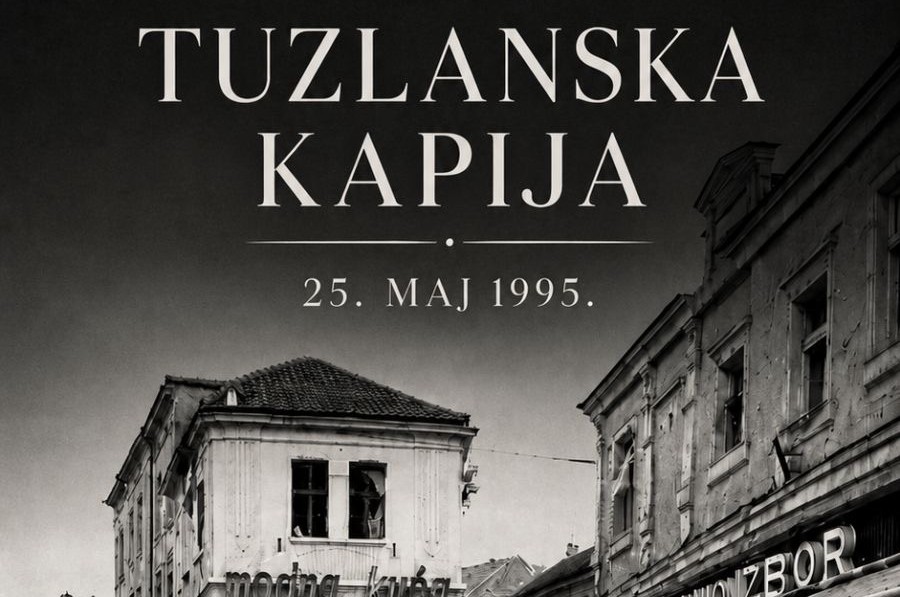
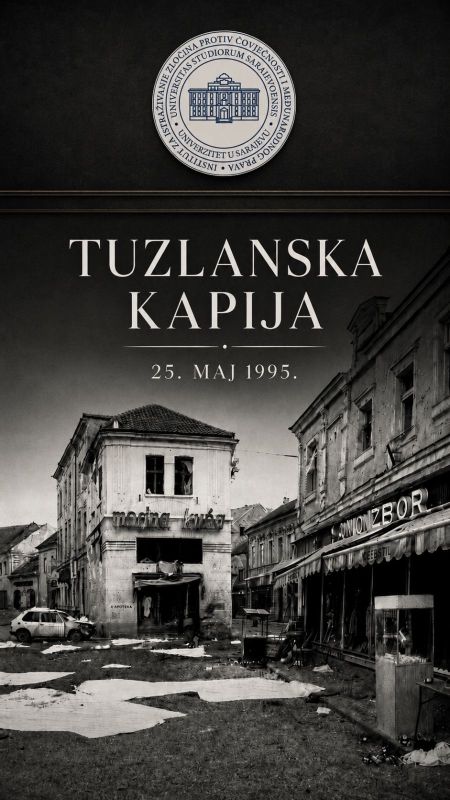
On May 25, 1995, a grenade fired from the direction of Ozren killed 71 civilians and wounded 173 others, making this one of the most massive shelling crimes during the aggression against the Republic of Bosnia and Herzegovina. On the occasion of the 31st anniversary of this crime, we remember, we commemorate, and we do not forget.
Below is an excerpt from a paper by Dr. Merisa Karović-Babić (Merisa Karović-Babić), Senior Research Associate at the University of Sarajevo – Institute for the Research of Crimes Against Humanity and International Law:
“Five hours before the massacre at Tuzla’s Kapija, in which 71 civilians were killed and 173 wounded, symbolic NATO strikes were carried out on ammunition depots of the VRS near Pale. The air strikes on the VRS occurred due to violations of the exclusion zone for heavy weapons around Sarajevo, thereby threatening not only the credibility of UNPROFOR but also NATO.
Following fears that NATO attacks could continue in the coming period, the Chief of the Main Staff of the VRS and closest associate of war criminal Ratko Mladić (Ratko Mladić), General Manojlo Milovanović (Manojlo Milovanović), reported that ‘the enemy’s actions were promptly responded to by engaging observed targets,’ mentioning artillery fire on the Hum repeater, UN checkpoints (except the Russian one), as well as on the enclaves of Srebrenica, Goražde, and Tuzla Airport, along with indications that further offensive operations were being planned.
The execution of these orders by the Main Staff of the VRS to corps commanders implied a demonstration of force against all cities in Bosnia and Herzegovina that were supposed to be under United Nations “protection,” whereby the symbolism of Youth Day would remain permanently engraved in the memory of the people of Bosnia and Herzegovina as a synonym for the killing of youth.”
The announcement of a general danger alarm in the Tuzla district and the shelling of Dubrava Airport with 13 grenades (19:30–20:46), where a UNPROFOR air base was located and where three grenades hit the helicopter landing area (approximately 13 km from the center of Tuzla), was, for the young people of Tuzla gathered at Kapija, merely a routine occurrence—something they had become accustomed to. Meanwhile, at 20:20, a grenade fired from Ozren also struck the area of the railway station.
Members of the Public Security Station (SJB) attempted to warn those gathered and remind them that a general danger alarm had been issued, but these warnings simply did not reach the citizens, who were eager for a brief sense of relaxation due to the symbolism of the date, as well as the fact that, after several rainy days, May 25 was sunny and clear, making the spring evening ideal for going out, walking, and socializing.
According to eyewitness estimates, there were several hundred young people at Kapija, as a handball match had ended around 8:00 p.m., resulting in an even larger crowd than usual. At 20:55, a grenade fired from VRS positions on Ozren exploded among the crowd gathered at the site, which was also the main meeting point in Tuzla.
Following forensic and criminal investigation and identification, which—according to the order of the investigating judge of the Higher Court in Tuzla—began half an hour before midnight and was completed during May 26, it was determined that 66 civilians were killed immediately, while in the following days five more people died from their injuries, bringing the total number of fatalities to 71.
The work was entrusted to medical specialists under the leadership of Assoc. Prof. Dr. Zdenko Cihlarž, specialist in forensic medicine and pathological anatomy, head of the Institute and the Department of Forensic Medicine at the Faculty of Medicine in Tuzla.
A detailed description of the methodology concerning the fatal injuries of each individual is included in the official Record of External Examination and Identification of the Victims of the Tuzla Massacre, along with published distressing photographs. The documentation also includes video materials, i.e., recordings of the victims made at the Institute of Forensic Medicine and the Institute of Pathology of the Clinical Center of the Faculty of Medicine in Tuzla.
The majority of the victims were second- and third-year university students. The youngest victim killed at Kapija was a two-and-a-half-year-old boy, Sandro Kalesić, while the oldest was 53-year-old Ilinka Tadić, a nurse from the Medical Center in Slavinovići.
(2).png)
(3).png)
.png)